OpenClaw and GDPR: Using an AI Assistant With Personal Data (2026)
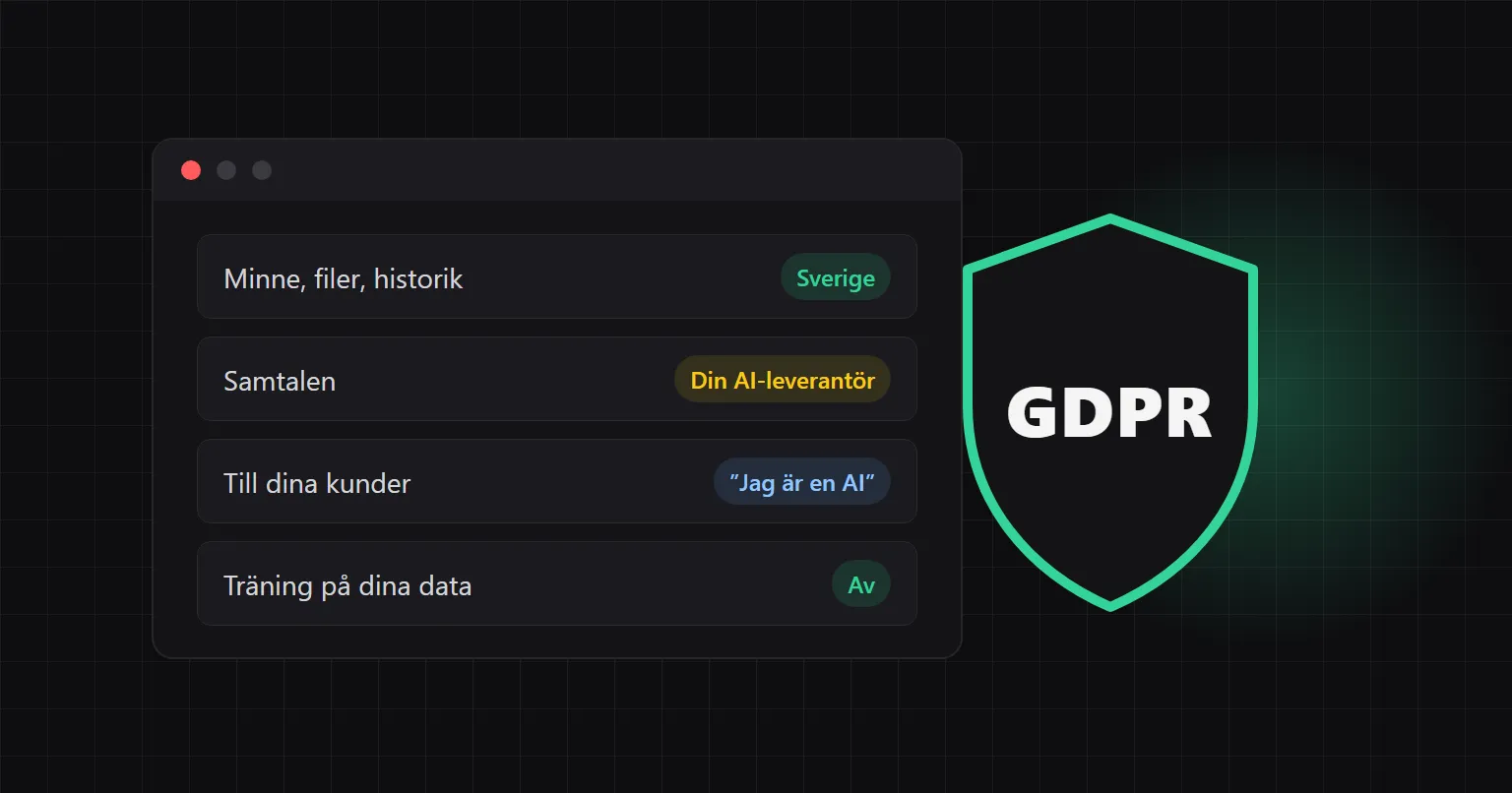
Short answer: If you use OpenClaw only for yourself, GDPR usually doesn't apply at all. If you use the assistant for work, with customers' or colleagues' details, you are responsible for that personal data. Then you need to know where the data goes (on the server running the assistant and at the AI provider), have agreements with those who process it, turn off training on your conversations, and tell people when they are talking to an AI.
This guide walks through it step by step. It is written for small business owners, consultants and anyone who wants to get it right, and it is not legal advice.
Personal use or work? That decides everything
GDPR has an exemption for purely personal use (Article 2(2)(c), the "household exemption"). If OpenClaw keeps track of your calendar, your shopping lists and what you promised your in-laws, you are essentially outside GDPR.
As soon as the assistant is used in a business, things change:
- it answers customers on Telegram or WhatsApp,
- it reads and summarises customer emails,
- it keeps notes about colleagues, patients, clients or students.
Your business is then the controller. Those who help you process the data, such as whoever runs the server and the AI provider, are normally processors. In a June 2026 report, the Swedish data protection authority IMY noted that these roles can't be decided from the type of service alone; you have to look at how the processing actually works. Make that assessment for your own setup.
Where does the data go when you use OpenClaw?
This is the most important question, and the answer is more than one place.
| What | Where it lives | Who controls it |
|---|---|---|
| The assistant's memory, notes, files and chat history | On the server running OpenClaw | You, or your hosting provider |
| The conversation itself while the assistant thinks | At the AI provider you connected (e.g. OpenAI or Anthropic) | The AI provider, under its terms |
| Messages in chat apps | At Telegram, WhatsApp, Slack, Discord, etc. | Each app |
The most common misunderstanding is that "the server is in Sweden" means everything stays in Sweden. It doesn't. Every time the assistant answers, the conversation is sent to the AI model, which runs wherever the AI provider has its data centres, often in the US.
If nothing should leave your own environment, there is one way: run a local model via Ollama. The trade-off is that small local models are noticeably weaker.
The AI provider: where most people get it wrong
How your AI provider handles conversations depends on which kind of account you connect.
ChatGPT on a personal plan (Free, Plus, Pro). According to OpenAI, conversations are used to improve the models by default unless you turn it off: Settings → Data Controls → Improve the model for everyone, switch it off. It applies to new conversations, not old ones.
ChatGPT Business, Enterprise and the OpenAI API. Here OpenAI does not train on what you send by default. For business use, this is the sensible choice.
Data in Europe. Since 2025 OpenAI has offered in-region processing in Europe for API projects created with Europe as their region. Availability has depended on the account tier, so check what applies to your account before relying on it.
Ask the same questions of Anthropic, Google and the rest: do they train on my data, where is it processed, and is there a data processing agreement (DPA)? The answers are in each provider's business terms.
The AI Act: what applies since 2 August 2026
The EU AI Act has one rule that affects almost anyone who lets an assistant talk to other people: Article 50. Since 2 August 2026, people interacting with an AI system must be told so, unless it is obvious.
If your OpenClaw assistant answers customers on Telegram or the web: say so clearly, for example in the first message ("Hi! I'm an AI assistant for …").
The heavy rules for high-risk AI, on the other hand, have been postponed. Under the Digital Omnibus, in force since July 2026, they apply to most high-risk systems only from 2 December 2027. An ordinary personal assistant or support bot is normally not high-risk. It becomes one if you use it for things like recruitment, credit scoring or grading. Be extra careful there already, because GDPR applies in full regardless.
Checklist: OpenClaw and GDPR in 10 minutes
- Decide whether it's personal or work. Work means GDPR applies and you are responsible.
- Pick the right AI account. A business account or the API for work, or at the very least training turned off.
- Get agreements in place. A data processing agreement with the AI provider and with whoever runs the server.
- Don't feed the memory more than needed. OpenClaw stores memories and notes as plain files. Don't ask it to remember ID numbers, health data or anything sensitive.
- Be able to delete. If someone asks, you must be able to remove their data. In practice that means clearing the assistant's memory files and chat history, not just the chat in the app.
- Say it's an AI. A first message goes a long way (Article 50).
- Do a DPIA when needed. Especially if the assistant handles sensitive data, many people, or makes decisions about people.
- Lock down the tech. Never expose the gateway to the internet; over 40,000 OpenClaw installations have been found open. Keep OpenClaw updated and be careful which skills you install.
Where ClawNest fits
We want to be clear about what we do and don't do.
- What lives with us (the assistant, its memory, files and chat history) runs on ClawNest's own hardware in Swedish data centres: Stockholm as the primary site and Örnsköldsvik for backups. Nothing sits with a US cloud provider.
- Conversations are processed by the AI provider you connect, with your own account and under its terms. That is why the choice of AI account above matters so much.
- Each assistant runs isolated and is updated for you, so security holes like the ones above get closed without you doing anything.
More on the setup at OpenClaw in Sweden and in our privacy policy.
FAQ
Does GDPR apply if I only use OpenClaw privately?
Usually not. Purely personal use falls under GDPR's household exemption. As soon as the assistant handles other people's data in a business, GDPR applies.
Does all data stay in Sweden if the assistant runs in Sweden?
No. The assistant's memory and files can live in Sweden, but conversations are sent to the AI provider you connected. Only a local model, for example via Ollama, keeps everything in your own environment.
Does OpenAI train on what I write to my OpenClaw assistant?
With a personal ChatGPT plan, conversations are used for training by default until you turn it off under Data Controls. With ChatGPT Business, Enterprise or the API, OpenAI doesn't train on your inputs by default.
Do I have to say my assistant is an AI?
Yes, if it talks to other people and it isn't obvious. Article 50 of the AI Act has required this since 2 August 2026.
Is OpenClaw a high-risk AI system?
Normally not. A personal assistant or support bot isn't high-risk. It can become one if you use it for recruitment, credit scoring or education, for example. The requirements for such systems apply from 2 December 2027.
Sources
- IMY: guidance on GDPR and AI (Swedish) and the report on controller roles when fine-tuning AI (June 2026)
- AI Act, Article 50 (transparency)
- Digital Omnibus on AI: new high-risk dates
- OpenAI: how to disable model training
- OpenAI: data residency in Europe
This is general information, not legal advice. If you handle sensitive personal data or are unsure about your role, talk to a lawyer or read IMY's guidance.
Try an OpenClaw assistant that runs in Sweden
Want your own assistant with its memory and files on Swedish hardware, without running a server? Try ClawNest free for 3 days. No card needed.